Showing posts with label non-fiction. Show all posts

Saturday, September 19, 2015

Review Round-up

As you might have guessed from the lack of posts recently, I ended up getting that teaching job! I've been back for two weeks now and it's been exhausting, but I think it's going pretty well. I am still planning to write more about this soon but I wanted to get some reviews that I've been sitting on out of the way. All three of these books come from my Tried and True list, so I've been making progress on that. It's ground to a halt now that I'm working again but at least I got to squeeze in a few good reads while I could!

The Tipping Point, Malcolm Gladwell (audiobook)
This was a surprisingly quick "read" and like Gladwell's other books, had a lot of interesting information. The premise here is twofold: 1) change is often quite gradual until a tipping point is reached and then there's a rapid shift, and 2) things that tend to go viral (or "create epidemics", as Gladwell called it over a decade ago, before the concept of "viral" became a thing) all tend to follow similar patterns in the way that they spread. Gladwell outlines the factors involved in something being "sticky" enough to become an epidemic. Some of the things discussed are common sense but a few things stood out for me. The research that went into the creation and success of Sesame Street, for example, was really interesting, especially since my daughter is just starting to discover Elmo and friends right now. 

Every time I listen to an audiobook, I comment on the author reading it. Gladwell reads this one, too, and for the first time, I think it may have been better if he didn't. His voice was so soft and soothing that it was hard to stay engaged sometimes. He could almost lull you to sleep. 

The Imaginary Girlfriend, John Irving
I bought this short memoir of Irving's at used book store several years ago, intrigued by the idea that a man who constantly insists that people stop looking for an author's life in his novels would have written a memoir. It turns out, he doesn't give us much to work with. If you're interested in his wrestling career, there is lots of high school and college wrestling minutiae. I would have been much more interested in his family life and writing career. There were a couple of surprises: Irving is dyslexic and actually hates the city of Vienna. The Vienna bit surprised me considering how much a part of his novels Vienna tends to be, and not usually in a negative way. It's worth the read for the sake of completeness if you are an Irving fan but you're not missing much otherwise.

And The Mountains Echoed, Khaled Hosseini (ebook)
Oh, how I loved this book! It's been over a week since I finished and I'm still thinking about it. 

If you are familiar with Hosseini's previous novels, The Kite Runner and A Thousand Splendid Suns, you probably already know that this, too, will break your heart. That's what Hosseini does. He pulls at your heart strings until they snap, but he does it so well. And The Mountains Echoed was much more subtle and less devastating than The Kite Runner, and not at all emotionally manipulative like I found A Thousand Splendid Suns to be. There is no gratuitous tragedy here, just the simple, beautiful heartbreak of people living their lives and making difficult choices that have lasting consequences across generations. I loved the story, I loved the characters, and I loved the way the story was told through the different viewpoints and formats. This is easily my favourite book of the year so far.

Sunday, August 30, 2015

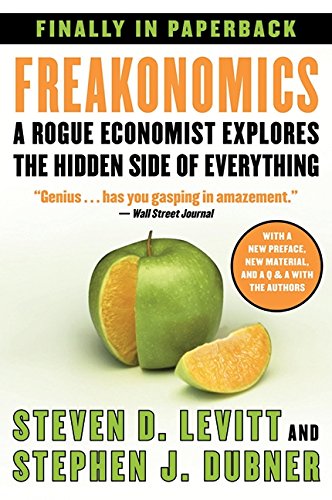
Review: Freakonomics

Freakonomics, Steven D. Levitt and Stephen J. Dubner 
Non-fiction, Ebook

In an attempt to make some progress on my Tried and True list, I had planned to start with The Tipping Point but got sidetracked a little. As it turns out, Freakonomics references The Tipping Point a few times and I ended up listening to the audiobook immediately afterward. They tied into each other nicely.

The underlying premise of Freakonomics is that people are driven by incentives, whether they be financial, moral, or social, and that conventional wisdom often gets those incentives wrong. In other words, people are not necessarily responding to the incentives that we think they are. Each chapter explores a different issue and tries to suss out what incentives are at play and how they affect outcomes.

Levitt covers a broad rage of topics, from cheating sumo wrestlers to the link between legalized abortion and crime rates, and the ideas presented are thought-provoking. The chapter discussing the inner economic workings of a crack-dealing gang in South Chicago was my personal favourite. There were many times, however, where I wished that the topics would have been discussed in greater depth, like teachers cheating on standardized tests or hidden prejudice. I was also expecting the book to present the actual data that Levitt's conclusions were based on but it didn't. All of the studies he referenced are cited at the end so the reader can look them up, but I would have found it useful to see some of it within the book. I like my charts and graphs, what can I say? 

All in all, I did really enjoy this book despite finding it a little unsatisfying. The authors went on to create a successful blog, podcast, and several more books after this one so at some point, I would like to check those out too.

P.S. A quick back-to-work update: I had an interview on Thursday for that teaching job I was interested in and should hear back Monday or Tuesday. Fingers are crossed!

Friday, July 17, 2015

Review: What to Expect The Second Year

What to Expect The Second Year, Heidi Murkoff 

Non-fiction, reference, parenting

Sometimes it feels like my daughter went from a sweet, immobile little baby to a full blown toddler over night. Suddenly, she's throwing food on the floor, getting into every nook and cranny she can find, and mimicking us saying "nonono" as she does the exact thing we'd tell her not to do. At first, it was a little overwhelming; just when we thought we had the whole baby thing figured out, we were back in uncharted territory.

I picked up WTE The Second Year from the library looking for some comfort and guidance. It's always reassuring to know that my kid is perfectly normal and that it's all a phase. I already knew that, of course, but it always helps to see it in print! I was particularly interested in a few specific things:
  • Dental hygiene. We were already brushing before bed most nights but I wanted to get into a more consistent, twice a day routine with an upgrade from her baby brush.
  • Eating habits. Between the food throwing, the lack of interest in cow's milk, and the 20th percentile weight she's been maintaining for a looooooong time, I had some concerns.
  • Behaviour/discipline. I know how to deal with teenagers since that's my job, but I wanted some tips on setting a good foundation and managing behaviour at this age.
The book addressed all of those and much more. It was actually very reassuring to know that we are mostly doing the "right" things, we just need to keep going. As fas the behaviour aspect, I was pleasantly surprised to find that most of what I already do in the classroom with teenagers applies to toddlers as well, just heavily simplified.

It was really helpful to learn how toddlers think at this age. For instance, they have a hard time sharing because they don't understand the concept of ownership yet. The book explains how their understanding of those concepts develop and gives some strategies for helping them learn. That stuff was very interesting to me and I feel that having a better idea of where A's frustrations come from can help me manage expectations and potential tantrums a little better. In that sense, I came away from this book feeling more confident and prepared.

The WTE books seem to get a bad rap, especially the pregnancy one, but I have to admit that I don't mind them. Their format can be obnoxious, sure, and they are written as if they are Cosmo articles in book form. But the information is good and thorough, which is the most important thing to me. That's why I keep coming back to them. WTE The Second Year is a good reference for this stage of development and worth checking out.

For more insight into toddler tantrums, I'd also recommend Dr. Harvey Karp's The Happiest Toddler On The Block. I'm not planning on a separate post for that because I didn't actually read the book. My library only had the dvd so I watched that instead. It was also very helpful. We don't really do the caveman thing with A, which is the main "gimmick" of this book/video, but there is a lot of useful information about the toddler mindset and managing tantrums. 

Monday, May 25, 2015

Review: Kitchen Confidential

Kitchen Confidential, Anthony Bourdain 
Audiobook, non-fiction, memoir

Audiobooks have found their way back into my life after an almost two year hiatus. I used to listen to them during my daily commute when I taught at a school that was 30 minutes away. Lately, I've been listening while I work around the house. It actually makes doing chores feel a little bit more like me-time.

Anthony Bourdain is a surprisingly (to me, anyway) good writer. His love of language almost rivals his love of food. He's a good story teller, self-aware and cynical, but funny. I enjoyed learning about his early exploits and his life as chef at La Brasserie Les Halles in New York. He also provides some pro tips for home cooks and advice for restaurant goers. The "What I Know About Meat" chapter was my favourite; it made me laugh out loud.

When it comes to memoirs in the audio format, I always prefer the ones narrated by their authors and this one is no exception. No one else would be able to do Bourdain's style the proper justice. That said, there are some pitfalls to the audio format. At times, Bourdain read too fast, especially at the end of some chapters so there was barely any transition. I'd expect a story to keep going but nope, he'd moved on to something completely different. Also making the flow awkward at times, the chapters alternated, seemingly at random, between Bourdain's history and his industry advice. It felt disjointed while listening to it. I don't think that would have been an issue if I was reading it and could see how the chapters were laid out. 

Overall, this was an interesting, entertaining read but I'd recommend getting the print version rather than audio.

Thursday, February 26, 2015

Review: Rocketeers

Rocketeers, Michael Belfiore
Non-fiction

I don't think I've mentioned my background on the blog before, though I have talked about teaching science. I actually have a degree in Planetary Science which I completed in 2006, so I was immersed in all things space during the time period covered by Rocketeers. I remember the excitement surrounding the X-Prize and the new possibilities represented by the success of SpaceShipOne. Reading this book brought me back to that time and made me miss it.

Belfiore discusses the big names in the Ansari X-Prize competition and describes those early years of the private space industry. It was interesting to see what motivated the different teams and the various approaches to their designs. Belfiore does a good job of conveying their optimism and the tension during the test firings. It was easy to get swept up in those parts of the book. Ultimately, however, I came away with mixed feelings. The book prompted me to look up a lot of the companies and people mentioned to see their progress and it was depressing to learn how many have failed or simply stopped. Most ran out of money, some just couldn't make it work. It's not surprising but it is disappointing.

My biggest take-away from Rocketeers actually had nothing to do with the science or space aspects. As I was reading, I found myself envious of the way these guys followed their passions. John Carmack of Armadillo Aerospace, for instance, would get together with a group on Tuesday nights and Saturdays to tinker with their designs. It occurred to me that I haven't had anything really and truly excite me like that in a long time. I started thinking about what my Tuesday Night Thing might be; what am I that passionate about, what fuels my creative fire? I am not sure anymore.


Wednesday, January 7, 2015

Books of 2014 - Pregnancy & Baby

Last year was a mixed bag when it came to reading. For the majority of the year, I read books related to pregnancy, birth, and babies. I tried to read novels too but they were a slog. It was hard to get into anything and maintain interest. In this post, I'm rounding up all of the baby related books and sharing my favourites.  

Pregnancy & Birth
I continued use The Mother of All Pregnancy Books as a reference (I discuss it in detail here). The "Complaints Department" chapter and chart of medications were the most useful. If I didn't already own that, I'd have bought the Mayo Clinic Guide to a Healthy Pregnancy. I borrowed that one from the library and really liked the section at the end of each month that broke down various symptoms and indicated if/when to report it to your doctor. Finally, though I am generally not a fan of Dr. Oz, I did enjoy YOU: Having a Baby. I didn't make it through the section on labour and delivery but everything up to that point was interesting. I liked that it wasn't the typical weekly or monthly guide. 

As we were gearing up for our baby showers, Baby Bargains was awesome for building our registry. That, along with the Lucie's List site helped us keep our registry pretty simple and focused on what we'd need.  It was helpful to have an idea of the different brands and what to watch out for.

In my birth story post, I mentioned that I had hoped for a med-free birth. To that end, I read Ina May's Guide to Child Birth and Husband Coached Childbirth by Bradley. If you are interested in going that route, I highly recommend Ina May's book. Initially, I was put off by the fact that the first half of the book consisted of birth stories; it felt too hippie dippy for me. By the end, though, I found it very empowering and increased my confidence a lot. The informational portion rubbed me the wrong way; it was biased, fear mongering, and not consistent with current research. The Bradley book had a lot of useful information but Bradley himself seems insufferable. 

Baby Care & Development
If I had to do it all over again, I'd spend less time focused on birth and more on what to do with a newborn baby. Many late night nursing sessions were spent googling various things I didn't know I would need to know. The books I have referred to regularly since A arrived are Baby 411 (by the same people who did Baby Bargains) and Dr. Sears' The Baby Book. My own parenting philosophy lies somewhere in between the two ends of the spectrum these books represent so I've found them to be a good combination. 

Thanks to the other moms in my birth month group on The Bump, I discovered The Wonder Weeks. I highly recommend this book and it's corresponding app. Everyone talks about the physical growth spurts but there are also cognitive ones, and those lead to predictable patterns of fussy behaviour. The book describes what baby is learning during each "leap" and how to help. I liked the suggestions for developmentally appropriate toys and games because my experience has been with older kids so I had no idea when it came to babies. The best thing about this book might be that it always reassures me that "this too shall pass." The app has a calendar that is customized to your baby's due date and describes each Wonder Week, along with some play suggestions. You could get by with just the app but it wouldn't hurt to check out the book from the library. It has a lot more detail and check lists.

At six months, we introduced solids. Since we are mainly doing baby led weaning, I read up on that as well. I definitely recommend reading this if you are interested in BLW because it provides information about choking vs. gagging, which is a common concern.

Infant Sleep
Oh, where do I begin with this one? Once the sleepy newborn stage wore off, we had nap issues galore. We could handle those because night sleep was going well. Around 4.5 months, that went to hell too. Two and a half months later with no end in sight, we were exhausted and reaching our breaking point. I read a lot of sleep books. I read a lot of blogs (Troublesome Tots is awesome). In the end, Ferber rescued us from the depths of sleep despair. Out of the many sleep resources I consulted and methods I tried, only a few were truly useful. These are my favourites:

The Happiest Baby Guide to Great Sleep, Dr. Harvey Karp - Similar to The Happiest Baby on the Block (we watched the dvd, it's good!) but more focused on sleep. I'm a big fan of Dr. Karp and the 5S's were a big help with our fussy newborn.

Healthy Sleep Habits, Happy Child, Dr. Marc Weissbluth - While Weissbluth is best known for being an advocate for full exctinction sleep training (crying it out with no soothing), that's not all this book is about. There is a lot of solid, helpful information here about sleep and sleep issues. It covers newborns through adolescents and this is the only book that discusses how to handle colicky babies in any detail. The formatting isn't great and often gets a little too academic, but still worth it for the information.

Solve Your Child's Sleep Problems, Dr. Richard Ferber - Everyone's heard of Ferber but few have actually read the book, so there are a lot of misconceptions. Ferber recommends graduated extinction, or crying it out with soothing, but just like Weissbluth, that's not all that is discussed here. Lots of good information, though not as thorough as Weissbluth.

If you are giving me the side-eye right now for recommending Weissbluth and Ferber, consider yourself lucky that you were never desperate enough to need either of them. And if you haven't had kids yet but think this is awful, never say never! That's how we started out too.

And there you have it. In the next post, I'll list my favourite non-baby related books from last year. That will be a much shorter list!

Friday, September 20, 2013

Review: The Boy Who Harnessed The Wind

[Today's usual TTC Friday post is going to be a few days late. I haven't been feeling great this week and I've been sitting on this review for a while, so it will have to tide you over. I'll be back soon!]
 
The Boy Who Harnessed The Wind: Creating Currents of Electricity and Hope, William Kamkwamba and Bryan Mealer
Audiobook
Rating: 3.0/5.0

Like China Road earlier this year, this is a book I only discovered because the author was interviewed on The Daily Show. Being a physics teacher, the story of William building a windmill for his village after teaching himself about electricity sounded interesting and potentially inspiring.

Here's a condensed description, taken from Amazon.ca:
The Boy Who Harnessed the Wind is the immensely engaging and inspiring true account of an enterprising African teenager who constructed a windmill from scraps to create electricity for his entire community. William Kamkwamba shares the remarkable story of his youth in Malawi, Africa—a  nation crippled by intense poverty, famine, and the AIDS plague—and how, with tenacity and imagination, he built a better life for himself, his family, and his village.

William's story is amazing to me for a few reasons. First, William grew up in a superstitious community. People tended to explain things away with magic and didn't really encourage scientific curiosity. William, however, never stopped asking questions no matter how many times the adults around him tried to dismiss them. Also, this young boy takes it upon himself to make his own education. He goes to the library to read books on the subjects he would have studied in school. He works to improve his English so that he can understand the physics books that captivate his interest. His determination and drive are inspiring.

As a teacher, I found myself wondering how many of our North American students would do what William did if they couldn't go to school? The way that our students take their education for granted often frustrates me, especially when I read books like this (see also: Three Cups of Tea, Little Princes, or Reading Lolita in Tehran). When my physics class began our electricity unit last semester, I showed my students a TED talk that William gave and told them his story, hoping to show them how the concepts they were learning are fairly basic but their applications can be life changing. I hoped that they, too, might get something out of William's determination and ingenuity. Unfortunately, it sparked nothing with that group. So disappointing.

All of this sounds like great stuff but the enthusiasm is entirely mine. The book itself is actually very dull. It's marketed as the story of the windmill but that part is just a very small portion toward the end. The majority of the book talks about William's childhood, some of his parents' history, his village, and Malawi. I get that all of those things are important for context and to convey the significance of the windmill for the people in William's village, but it was long and meandering, and at times just boring.

If you're interested, here is the second of the two TED talks that William has given:


There is also a documentary in the works. The video at that link has a more current interview with William and talks about what he's been up to in recent years.

Overall, William's story is worth hearing and learning about but the book may not be the best medium to do it.

Sunday, May 12, 2013

Review: Committed

Committed: A Love Story, by Elizabeth Gilbert
Audiobook
Rating: 3.0/5.0

First of all, can we talk about the title of this book? Its original subtitle was "A Skeptic Makes Peace With Marriage." Between the time that I saved this book to my library wishlist and the time that I actually got around to reading it, it had changed to "A Love Story." I don't get the need for this, other than marketing. Considering that one of the most common criticisms of Committed is that it's not like Eat, Pray, Love, this seems to be deliberately misleading people. The original subtitle is far more accurate.

At the end of Eat, Pray, Love, Gilbert meets Felipe and the two fall in love. In Committed, they learn that if they want to live together in the United States, they are going to have to get married. As both of them are divorced and swore that they'd never remarry, this is not good news. Adrift in Southeast Asia while they wait for Felipe's fiance visa to be approved, Gilbert sets out to learn about marriage and to find a way to make peace with the idea of being married again. This is not a sequel to Eat, Pray, Love; the book is partially a memoir but is mostly a dissertation on marriage in a historical, social, and religious context.

It was an interesting read, especially against the backdrop of the same-sex marriage debate going on in the US. The people who argue against it like to argue that marriage has always been defined as being between a man and a woman, and that it's a sacred institution. As Gilbert discovered, none of that is true. In ancient Rome, for instance, it was perfectly legal for two men to marry when circumstances made it beneficial for them to do so. Most of the time, marriage was about politics or convencience. Not at all sacred. The church itself was initially against marriage altogether until it realized that people were going to do it anyway. Unable to prevent it, they began trying to control it instead.

Gilbert's research brought up several facts and ideas that I found interesting/thought-provoking:
  • Western culture has a different view on the purpose of marriage than the rest of the world and we place a very high degree of importance in its role in our lives. We also tend to expect our spouse to be responsible for our own personal fulfillment. Not surprising, then, that we tend to be more unsatisfied and disappointed.
  • The laws of coverture. Ridiculous.
  • There is an actual genetic basis for the dad vs. cad theory. There is a particular male gene, the length of which can predispose a man to either father a child and take off (the cad), or stick around and raise his kids (the dad). 
  • Seagulls mate for life. Who knew? But even among seagulls, there is a 25% "divorce" rate. I found it interesting that there is such a thing as a fundamental compatibility (or lack thereof) between individuals.
  • Educated women tend to have more solid marriages. And in societies where women become financially independent, marriage is the first thing that changes. This is because a woman's "need" or motivation for marriage is lessened or removed.
  • The Marriage-Benefit Imbalance. There is a study showing that while men benefit socially, physcologically, and physically from marriage, it has the opposite effect on women. When I tried to find more on this, I came across a series of articles on Psychology Today which debunk it instead. It starts here.

In addition to the research, Gilbert shares stories of her mother and grandmother's marriages. I enjoyed that and it was amazing to hear how much things changed in just one generation. The book was well written but did get repetitive at times. Also, as much as I like her, Gilbert came across as someone who, even after her journey in Eat, Pray, Love, is still insecure and worried about what people will think. There are many passages in the book where she'll make a statement and then, in anticipation of how someone might criticize or misinterpret her intentions, she'll qualify and defend it. That got annoying after a while. Finally, her entire premise was about making peace with her own second marriage but after laying out all of her research and reflections, Gilbert doesn't really discuss how she ultimately did make that decision to go forward and be ok with it. It just happens. I got to the end and felt like something was missing.

Overall, while it could have been better, the book was still a worthwile read. It was interesting and I learned some new things. It made me reflect on my own relationship and marriage.


Thursday, March 14, 2013

Review: Little Princes

Little Princes: One Man's Promise to Bring Home the Lost Children of Nepal, Conor Grennan
Audiobook
Rating: 4.5/5.0

Little Princes was a case of love at first listen. I'd been putting it off for a while because the description made me think it would be very similar to Three Cups of Tea, which I liked but didn't want to rehash. I'm glad gave it a shot because it's one of my favourites of the year so far.


Conor Grennan decides to travel around the world for a year, beginning with a three month stint volunteering at an orphanage in Nepal. He readily admits that it wasn't the actual volunteering or the orphans that motivated him, rather the idea of it and of being able to impress people by saying that he did it (here's an article he wrote for the Huffington Post about whether or not one's initial motivation really matters). Once in Nepal, though, he establishes a connection to the kids and when he learns the truth of their circumstances, he is compelled to help.

Grennan reads the audiobook himself, which is great because his enthusiasm and passion really shine through in his reading. He clearly loves Nepal and all of the kids that he's worked with. I loved all of the sections where he talked about the kids because of that enthusiasm.

Grennan is a very engaging narrator. It's easy to like him and get completely drawn into his story. And the story has a little bit of everything: memoir, travelogue, history, adventure, love story. Grennan's efforts to start his own organization and to find the childrens' families are compelling, though the story did drag a bit when he was away from the kids (why I gave the book a 4.5 instead of a perfect 5.0). His long-distance courtship of Liz was sweet and fun to follow; I couldn't help but root for them to get together. Grennan is also a great descriptive writer; I'm a visual person and prefer the written word but I could easily picture everything he was talking about.

My favourite thing about Little Princes is how genuine Grennan appears to be. The book was written several years after the experiences that he details, and Grennan has obviously used that time to reflect on his motivations and his experiences. He is honest and self-aware, which is refreshing. He seemed to be a bit of a douchebag before his trip (the friend he meets in Bangkok reflects that) but he freely admits to it. Later in the book, when he starts interviewing the families of the children, he admits that his initial approach was not the best way to go and that he had, in fact, acted like a jerk.  He just seems very human and while I wouldn't have the cojones to do what he has done, I felt like I could still relate to him.

I highly recommend this book. It's entertaining, it's informative, and it's thought-provoking. If you liked Three Cups of Tea, this one is even better.

Monday, February 18, 2013

Review: Bossypants

Bossypants, Tina Fey
Audiobook
Rating: 3.5/5.0

In the mood for something lighter on the drive to/from work, I've been listening to Tina Fey's Bossypants. Since Fey reads it herself, it is very funny and entertaining. It does make a difference when the author does the reading. Case in point: Steven Tyler's memoir, Does The Noise In My Head Bother You?, was read by a guy who tried to sound like Tyler and that was funny at times for all the wrong reasons.

In Bossypants, Fey talks about various parts of her life, from her awkward teenage years through her days working at The Second City in Chicago, to her time on Saturday Night Live and eventually 30 Rock. I really enjoyed the Don Fey chapter, where she describes how badass her father is, and the chapter on her disastrous honeymoon cruise to Bermuda. Fey also details how she came to play Sarah Palin in the famous SNL parodies, which was a very interesting behind-the-scenes glimpse into how the media and politics come together during an election campagin. The book ends with Fey trying to decide whether or not to have a second child. I could relate to a lot of her feelings on that subect, though we are only trying for our first right now.

One of the most interesting parts of the book for me was the way that Fey discussed being a woman in a traditionally male-dominated field. She specifically mentions the institutionalised sexism she encountered at The Second City. If you're interested, zeteticat from Bookish Habits transcribed that part in her review, here.

As much as I enjoyed Bossypants, I only gave it a 3.5 because ultimately, it wasn't very satisfying. Fey would sometimes go off on tangents that were amusing (surviving photoshoots for magazines, the different writers on 30 Rock and their MVP jokes) but I would have rather heard more about her own life experiences. She gives snapshots about certain parts of her life but there is a lot that we don't hear about. Her response would probably be that it's none of our business, which is fair, but then how much of a memoir is it? As a result, I didn't come away from this book with as much insight into her as I'd expected.

I'd still recommend Bossypants but for now, Craig Ferguson's American On Purpose remains my favourite celebrity memoir.


Tuesday, January 29, 2013

Road Trip

China Road: A Journey Into the Future of a Rising Power, Rob Gifford
Non-fiction
Audiobook
Rating: 4.0/5.0

Stories about, or set in, China have always fascinated me. Maybe it's because the culture is so completely different from anything I have ever experienced. One of the most memorable books that I've ever read is Wild Swans: Three Daughters of China, by Jung Chang. It's non-fiction and it was the first time I'd read anything about Chinese history and politics. It both intrigued and repulsed me at the same time.

Not long after reading Wild Swans, I saw Rob Gifford on The Daily Show (back in 2007) and his interview is what sparked my interest in this book. If you're in the US, you can see his interview here. If you're in Canada, you can dig through the Comedy Network website to get to it. Outside of those countries, I have no idea, sorry. Stupid geoblocking.

China Road is, essentially, a road trip story. Gifford was the China bureau correspondent for NPR for about six years. When his time in China ended, he decided to make the journey across the country on Route 312 before leaving for good. This road runs from one end of China to the other and Gifford likens it to Route 66 in the US. He tells the story of China's past, present, and future through the people and places that he visists along the way. You can read serialized excerpts that Gifford posted as he was making the trip on the NPR website, here.

What I took away from this book, which wasn't a major revelation for me but was interesting nonetheless, is that China is a mess of contradictions. They are working to secure their place as a global economic superpower but at the same time, they are clinging to the past in ways that will never allow them to truly progress. The details Gifford gives about Chinese history gave me a new perspective on the Chinese way of doing things; he made it make sense. For instance, Gifford suggests that the Chinese focus on perfecting ideas that already exist rather on innovation because their guiding principles are still rooted in the past. Their ancestors were not innovators; they saw no need to develop new ideas and make big changes to the status quo. Thus, there is no need to do so now. Gifford argues that the Chinese will eventually need to encourage innovation if they want to compete with their global counterparts in the long run.

Gifford highlights some of the progress that has been made since the end of Chairman Mao's regime and discusses the ways in which China is still recovering from that time. Some parts were inspiring: the people in my generation that are studying and working to create opportunities for themselves, and to create lives that are their own. Other parts were appalling: the AIDS villages that were created by a careless government, who now has to pay those residents to take their medication (while at the same time displaying billboards touting that preventing AIDS is "everyone's responsibility" depsite it being a disease they spread in the first place), the forced abortions for women who have already had two children, regardless of the stage of pregnancy and the willingness of the mother to submit to the procedure. It was a learning experience.

Just last week, I came across an NPR article about a man in Beijing that opened up a Central Perk cafe that is an exact replica of the coffee shop from Friends. The man's sentiments about why the Chinese like Friends so much and what the cafe represents echoes a lot of what the people in Gifford's book had to say, about the yearning for freedom of choice in their own lives. After having read China Road, I understood that article in a way I wouldn't have before.


Is China Road worthwhile? Yes. But I'll end this review with a plug for Wild Swans. Even if you don't have any interest in China Road, I highly recommend Wild Swans. It will make you angry, it will break your heart, but it will inspire you.