Showing posts with label review. Show all posts

Saturday, September 19, 2015

Review Round-up

As you might have guessed from the lack of posts recently, I ended up getting that teaching job! I've been back for two weeks now and it's been exhausting, but I think it's going pretty well. I am still planning to write more about this soon but I wanted to get some reviews that I've been sitting on out of the way. All three of these books come from my Tried and True list, so I've been making progress on that. It's ground to a halt now that I'm working again but at least I got to squeeze in a few good reads while I could!

The Tipping Point, Malcolm Gladwell (audiobook)
This was a surprisingly quick "read" and like Gladwell's other books, had a lot of interesting information. The premise here is twofold: 1) change is often quite gradual until a tipping point is reached and then there's a rapid shift, and 2) things that tend to go viral (or "create epidemics", as Gladwell called it over a decade ago, before the concept of "viral" became a thing) all tend to follow similar patterns in the way that they spread. Gladwell outlines the factors involved in something being "sticky" enough to become an epidemic. Some of the things discussed are common sense but a few things stood out for me. The research that went into the creation and success of Sesame Street, for example, was really interesting, especially since my daughter is just starting to discover Elmo and friends right now. 

Every time I listen to an audiobook, I comment on the author reading it. Gladwell reads this one, too, and for the first time, I think it may have been better if he didn't. His voice was so soft and soothing that it was hard to stay engaged sometimes. He could almost lull you to sleep. 

The Imaginary Girlfriend, John Irving
I bought this short memoir of Irving's at used book store several years ago, intrigued by the idea that a man who constantly insists that people stop looking for an author's life in his novels would have written a memoir. It turns out, he doesn't give us much to work with. If you're interested in his wrestling career, there is lots of high school and college wrestling minutiae. I would have been much more interested in his family life and writing career. There were a couple of surprises: Irving is dyslexic and actually hates the city of Vienna. The Vienna bit surprised me considering how much a part of his novels Vienna tends to be, and not usually in a negative way. It's worth the read for the sake of completeness if you are an Irving fan but you're not missing much otherwise.

And The Mountains Echoed, Khaled Hosseini (ebook)
Oh, how I loved this book! It's been over a week since I finished and I'm still thinking about it. 

If you are familiar with Hosseini's previous novels, The Kite Runner and A Thousand Splendid Suns, you probably already know that this, too, will break your heart. That's what Hosseini does. He pulls at your heart strings until they snap, but he does it so well. And The Mountains Echoed was much more subtle and less devastating than The Kite Runner, and not at all emotionally manipulative like I found A Thousand Splendid Suns to be. There is no gratuitous tragedy here, just the simple, beautiful heartbreak of people living their lives and making difficult choices that have lasting consequences across generations. I loved the story, I loved the characters, and I loved the way the story was told through the different viewpoints and formats. This is easily my favourite book of the year so far.

Sunday, August 30, 2015

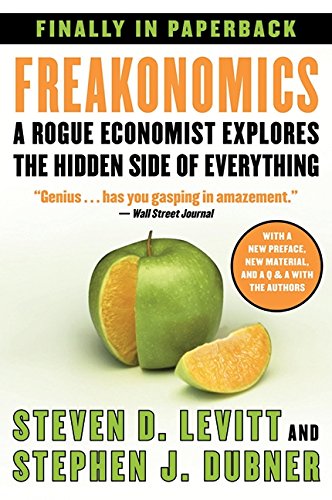
Review: Freakonomics

Freakonomics, Steven D. Levitt and Stephen J. Dubner 
Non-fiction, Ebook

In an attempt to make some progress on my Tried and True list, I had planned to start with The Tipping Point but got sidetracked a little. As it turns out, Freakonomics references The Tipping Point a few times and I ended up listening to the audiobook immediately afterward. They tied into each other nicely.

The underlying premise of Freakonomics is that people are driven by incentives, whether they be financial, moral, or social, and that conventional wisdom often gets those incentives wrong. In other words, people are not necessarily responding to the incentives that we think they are. Each chapter explores a different issue and tries to suss out what incentives are at play and how they affect outcomes.

Levitt covers a broad rage of topics, from cheating sumo wrestlers to the link between legalized abortion and crime rates, and the ideas presented are thought-provoking. The chapter discussing the inner economic workings of a crack-dealing gang in South Chicago was my personal favourite. There were many times, however, where I wished that the topics would have been discussed in greater depth, like teachers cheating on standardized tests or hidden prejudice. I was also expecting the book to present the actual data that Levitt's conclusions were based on but it didn't. All of the studies he referenced are cited at the end so the reader can look them up, but I would have found it useful to see some of it within the book. I like my charts and graphs, what can I say? 

All in all, I did really enjoy this book despite finding it a little unsatisfying. The authors went on to create a successful blog, podcast, and several more books after this one so at some point, I would like to check those out too.

P.S. A quick back-to-work update: I had an interview on Thursday for that teaching job I was interested in and should hear back Monday or Tuesday. Fingers are crossed!

Wednesday, July 29, 2015

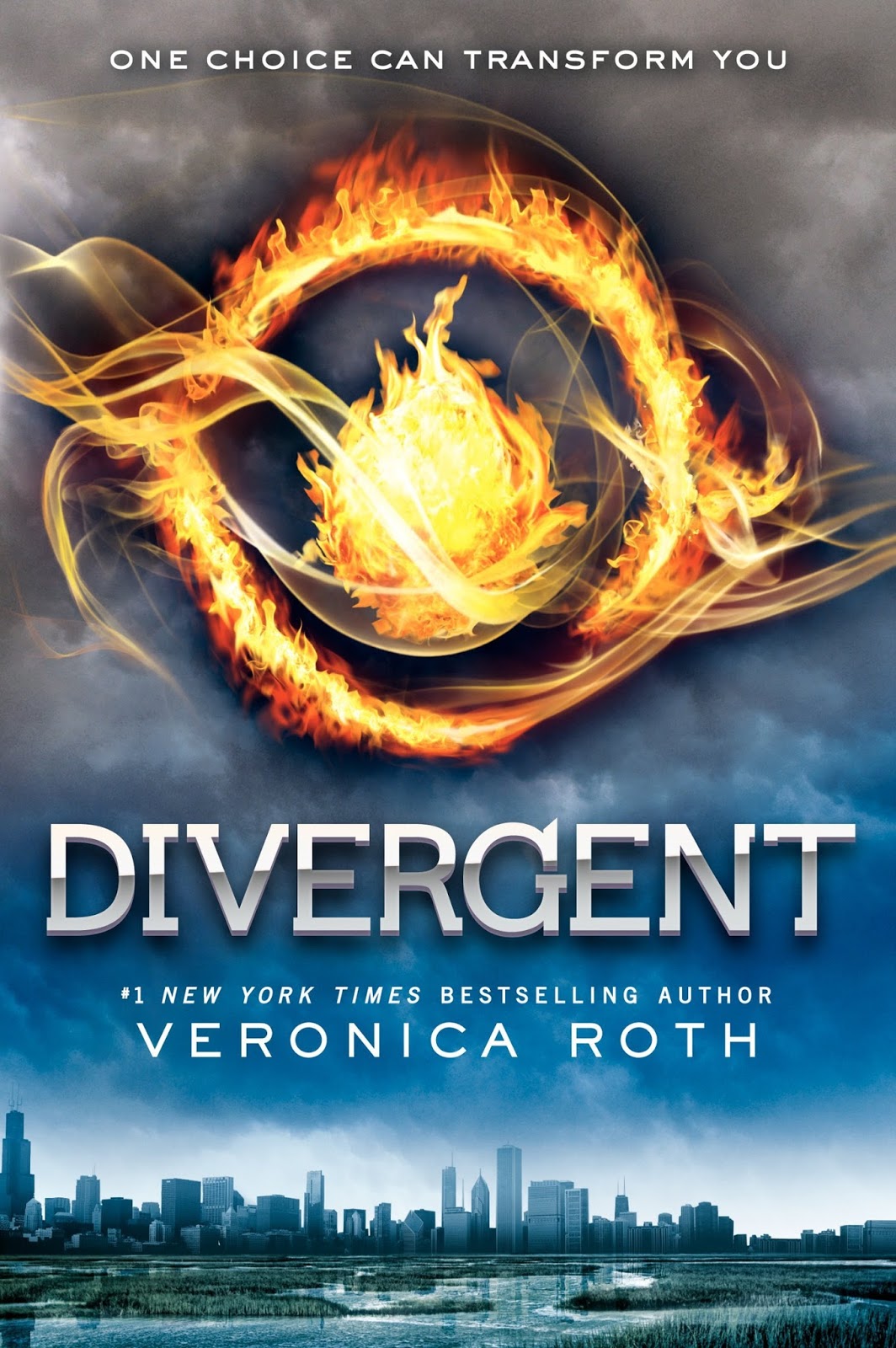
Review: Divergent

Divergent, Veronica Roth
Divergent series #1
Young Adult Fiction, Dystopian

Finally. FINALLY.

This was the "I don't want to put it down and you can't make me" kind of book I've been waiting for. I got the boxed set for Christmas and I'm glad the other two books are already waiting in the wings.

There has been a lot of hype over the Divergent series for the last couple of years but I fell down The Hunger Games rabbit hole instead. One of my book club friends actually described Divergent as "The Hunger Games with more rules." She wasn't too far off. There are a lot of similarities and Divergent is pretty formulaic. All the usual YA tropes are there: a teenager who has some special skills, doesn't fit in with her peers, gets separated from her family, and is the only one who can save them all. Unlike The Hunger Games, however, there is no annoying love triangle and Tris, the main character, is more relatable than Katniss. 

At first, I will admit that I was underwhelmed and thought the premise was kind of stupid. The series is set in a dystopian Chicago where everyone is separated into one of five factions according to their dominant personality trait. Tris has the dilemma of not fitting into just one faction, making her "divergent." The factions came about as a way to maintain peace but this seemed like an oversimplification of complex issues to me, and the idea that people can be classified according to just one trait seemed ridiculous. But as I kept reading, it all came together. We meet Tris just as she turns sixteen. She's had a very sheltered upbringing and her understanding of her world is pretty limited. Since the novel is told from her perspective, our understanding is limited too and it grows with her. I appreciated that.

I took a bit of a break to read Freakonomics but I'm already itching to get back to this series and find out what happens next. I love it when a book lives up to its hype and this one was a definite winner!


Friday, July 17, 2015

Review: What to Expect The Second Year

What to Expect The Second Year, Heidi Murkoff 

Non-fiction, reference, parenting

Sometimes it feels like my daughter went from a sweet, immobile little baby to a full blown toddler over night. Suddenly, she's throwing food on the floor, getting into every nook and cranny she can find, and mimicking us saying "nonono" as she does the exact thing we'd tell her not to do. At first, it was a little overwhelming; just when we thought we had the whole baby thing figured out, we were back in uncharted territory.

I picked up WTE The Second Year from the library looking for some comfort and guidance. It's always reassuring to know that my kid is perfectly normal and that it's all a phase. I already knew that, of course, but it always helps to see it in print! I was particularly interested in a few specific things:
  • Dental hygiene. We were already brushing before bed most nights but I wanted to get into a more consistent, twice a day routine with an upgrade from her baby brush.
  • Eating habits. Between the food throwing, the lack of interest in cow's milk, and the 20th percentile weight she's been maintaining for a looooooong time, I had some concerns.
  • Behaviour/discipline. I know how to deal with teenagers since that's my job, but I wanted some tips on setting a good foundation and managing behaviour at this age.
The book addressed all of those and much more. It was actually very reassuring to know that we are mostly doing the "right" things, we just need to keep going. As fas the behaviour aspect, I was pleasantly surprised to find that most of what I already do in the classroom with teenagers applies to toddlers as well, just heavily simplified.

It was really helpful to learn how toddlers think at this age. For instance, they have a hard time sharing because they don't understand the concept of ownership yet. The book explains how their understanding of those concepts develop and gives some strategies for helping them learn. That stuff was very interesting to me and I feel that having a better idea of where A's frustrations come from can help me manage expectations and potential tantrums a little better. In that sense, I came away from this book feeling more confident and prepared.

The WTE books seem to get a bad rap, especially the pregnancy one, but I have to admit that I don't mind them. Their format can be obnoxious, sure, and they are written as if they are Cosmo articles in book form. But the information is good and thorough, which is the most important thing to me. That's why I keep coming back to them. WTE The Second Year is a good reference for this stage of development and worth checking out.

For more insight into toddler tantrums, I'd also recommend Dr. Harvey Karp's The Happiest Toddler On The Block. I'm not planning on a separate post for that because I didn't actually read the book. My library only had the dvd so I watched that instead. It was also very helpful. We don't really do the caveman thing with A, which is the main "gimmick" of this book/video, but there is a lot of useful information about the toddler mindset and managing tantrums. 

Sunday, June 28, 2015

Review: The Brass Verdict

The Brass Verdict, Michael Connelly
The Lincoln Lawyer/Mickey Haller series #2
Fiction, Ebook

The months of May and June are what I call "Family High Season" because during these two months, we celebrate all three of our birthdays, my dad's birthday, and our wedding anniversary. That's on top of Mothers' Day and Fathers' Day. It's a busy time, to say the least, and why things have been so quiet around here. Between all of that celebrating, there hasn't been much time for blogging or reading.

In need of something (relatively) light and fast-paced to help pick up momentum, I decided to revisit The Lincoln Lawyer series. The Brass Verdict is the second book in the series, picking up about a year after the first one ends. When a colleague is murdered and his entire practice is left to Mickey Haller (aka the Lincoln Lawyer, so called because his office is the back of his Lincoln Town Car), he's thrown back into the game after a year away. One of the clients he inherits is a big shot Hollywood executive about to go on trial for double murder. Haller has to figure out how to defend this guy, why his colleague was murdered, and whether the two are connected without making himself another target.

I read the first book a couple of years ago because the movie trailers looked interesting. I really enjoyed it and the movie was well done too. Matthew McConaughey is perfect and it was hard not to picture him as Mickey Haller while reading The Brass Verdict. Just like the first book, I enjoyed Haller's sense of humour and his somewhat loose ethics. I enjoyed the courtroom drama, though the twist at the end was a bit melodramatic and predictable. I also enjoyed the developing relationship between Mickey and Detective Harry Bosch, who is the star of another series by Michael Connelly. The Brass Verdict was exactly what I needed and if you are interested in crime or legal dramas, definitely check out this series!

Here's the trailer for The Lincoln Lawyer. It's too bad they didn't end up franchising it.


Thursday, June 4, 2015

Review: Pattern Recognition

Pattern Recognition, William Gibson
Fiction, book club

It's been a couple of weeks since I finished Pattern Recognition and I still don't have much to say about it. It was a book club selection, one that I'd been looking forward to since it was different from our usual fare. Unfortunately, it didn't live up to expectations.

Kind of like Such A Long Journey, the blurb led me astray. I thought that there was going to be mystery, suspense, maybe some danger. There was a mystery but the whole thing just wasn't very engaging. I kept thinking, "Is this all there is? Really?" I never believed Cayce, the main character, was in any real danger. I still don't fully understand the resolution. All in all, it was a disappointment.

Almost halfway in, this year isn't shaping up to be a very satisfying one as far as books go. Any good recommendations to turn this ship around, kind readers?

Monday, May 25, 2015

Review: Kitchen Confidential

Kitchen Confidential, Anthony Bourdain 
Audiobook, non-fiction, memoir

Audiobooks have found their way back into my life after an almost two year hiatus. I used to listen to them during my daily commute when I taught at a school that was 30 minutes away. Lately, I've been listening while I work around the house. It actually makes doing chores feel a little bit more like me-time.

Anthony Bourdain is a surprisingly (to me, anyway) good writer. His love of language almost rivals his love of food. He's a good story teller, self-aware and cynical, but funny. I enjoyed learning about his early exploits and his life as chef at La Brasserie Les Halles in New York. He also provides some pro tips for home cooks and advice for restaurant goers. The "What I Know About Meat" chapter was my favourite; it made me laugh out loud.

When it comes to memoirs in the audio format, I always prefer the ones narrated by their authors and this one is no exception. No one else would be able to do Bourdain's style the proper justice. That said, there are some pitfalls to the audio format. At times, Bourdain read too fast, especially at the end of some chapters so there was barely any transition. I'd expect a story to keep going but nope, he'd moved on to something completely different. Also making the flow awkward at times, the chapters alternated, seemingly at random, between Bourdain's history and his industry advice. It felt disjointed while listening to it. I don't think that would have been an issue if I was reading it and could see how the chapters were laid out. 

Overall, this was an interesting, entertaining read but I'd recommend getting the print version rather than audio.

Monday, May 4, 2015

Review: All Together Dead

All Together Dead, Charlaine Harris
Southern Vampire/Sookie Stackhouse Series #7
Fiction, ebook

Ugh.

Oh, you wanted to know more? Unfortunately, I don't have a lot of positive things to say about this one.

The first few books in this series were fun and entertaining but now it's starting to feel ridiculous. The writing is inconsistent, the love triangles (or polygons) are getting old, and it all seems a little over the top. There are too many characters and too many subplots and for some reason, Harris feels the need to throw them all into one book. I could barely remember anything from the last book (probably because I read it nearly two years ago, while on this cruise), which didn't help, so I was pretty confused at first and had a hard time getting into the story. 

This might be the end of the road for me and Sookie Stackhouse. The premise of the next book intrigues me but I'm not sure if I want to continue. There's so much better out there to spend my time on.

Wednesday, April 22, 2015

Review: Such a Long Journey

Such a Long Journey, Rohinton Mistry
Historical fiction

There's a mall downtown that my parents used to take me to when I was younger. We'd usually go during the holidays to see all the decorations. On the second level, there was a walkway lined with windows that connected two parts of the mall above the street. My parents would get cappuccinos from the Second Cup that used to be there and we'd sit by the windows watching the traffic go by while I spooned the cinnamon dusted foam off my mom's coffee. That mall still exists but is mostly office space now and has since been renamed. It's one of several places that has changed names over the years but that I still call by its old name. The mall was what came to mind when I read this passage in Such a Long Journey:

"Names are so important. I grew up on Lamington Road. But it has disappeared, in its place is Dadasaheb Bhadkhamkar Marg. My school was on Carnac Road. Now suddenly it's on Lokmanya Tilak Marg. I live at Sleater Road. Soon that will also disappear. My whole life I have come to work at Flora Fountain. And one fine day the name changes. So what happens to the life I have lived? Was I living the wrong life, with all the wrong names? Will I get a second chance to live it all again, with these new names? Tell me what happens to my life. Rubbed out, just like that? Tell me!"

Using the old names is way of hanging on to that life and those memories. It's a way of clinging to the past, like Gustad, the novel's main character, tends to do. There are many journeys in the book, both literal and figurative, that serve to push Gustad toward letting go of the past and start moving forward.

The novel takes place in 1971, when war is brewing between India and Pakistan. This is a time in India's history I was not familiar with since most books I gravitate to are set during Partition (1947). That made it interesting. The story itself was interesting as well, with a good mix of characters and a bit of mystery. The different personalities and goings on of the residents of Khodadad Building were entertaining.

As much as I enjoyed the book, I have to admit that when I finished, I felt like I'd missed something or maybe some of it went over my head. It might have been that my expectations were off; the blurb implied that Roshan's (Gustad's daughter) illness and Gustad's conflict with his eldest son were going to be a really big deal but they were more background issues that just kind of fizzled out. Then again, I have found myself thinking about the book since finishing it so maybe it's one of those books that you appreciate more after reading it, as it sits with you?

Thursday, April 9, 2015

Review: The Bean Trees

The Bean Trees, Barbara Kingsolver
Fiction

The Bean Trees is Barbara Kingsolver's debut novel. Kingsolver is one of my favourite authors and The Poisonwood Bible is one of my favourite books so my expectations were high. Like The Poisonwood Bible, there are memorable characters here. And like Prodigal Summer, there are vivid descriptions of the landscape. The Bean Trees, however, doesn't quite have the lasting impact of either.

The novel follows Taylor Greer as she sets out to leave her small-town Kentucky life behind and start fresh in Arizona. Along the way, she ends up with a baby that someone leaves in the passenger seat of her car. As ridiculous as that might sound, it is actually a good story that touches on a lot of social issues. Kingsolver doesn't really unpack those issues, so it was a little unsatisfying when I was expecting something meatier. At the same time, the book probably would have been depressing if she had.

I liked Taylor a lot and wanted her to succeed. I also enjoyed her humour. She actually reminded me of Sookie Stackhouse, maybe with more street smarts. The one thing I did have a hard time getting my head around was how quickly and easily she decided to keep the baby. She prides herself on making it through high school without getting pregnant and looks down on the other girls in her small town who weren't so lucky, or who got married and pregnant right after graduating. So, she leaves to make something of herself in a better place and the first thing she does is...pick up a baby? That contradiction is never addressed.

Overall, this was an enjoyable and well written debut novel. If you're a Kingsolver fan, it's worth reading. If you haven't read any of her novels yet, I'd suggest starting with The Poisonwood Bible or Prodigal Summer instead.

Thursday, March 5, 2015

Review: Honolulu

Honolulu, Alan Brennert 
Historical Fiction, E-book

So close. This book came SO close to being my first favourite book of the year. A week ago, I was all ready to rave about it here. Then I kept reading and it turned into Forrest Gump Does Hawaii. It recovered in the last few chapters but I just wasn't as into it anymore.

Honolulu takes place in Hawaii during the period between 1915 and the mid 1930s. Jin arrives there as a teenage "picture bride" hoping to get an education, something forbidden to girls in Korea at the time. The novel follows her new life and also chronicles a changing Honolulu. DH and I honeymooned in Hawaii and it holds a very special place in my heart, which is partly what drew me to this book. That, and I love me some good historical fiction.

The first two thirds of the book were really good. I liked Jin and could relate to her. I was rooting for her to be successful. The story moved along well and the Hawaiian history was interesting, too. When the focus shifted away from Jin in the last third, the book got too bogged down in history and started to lose me. At times, it felt like the author was trying to check off a bunch of important people and events from a history text book. It was hard to believe that Jin would just happen to meet all of these people and be so involved with all of these events. I mean, minor spoiler alert, she even invents the Hawaiian shirt. Really?! Jin also seemed to become a self-righteous know-it-all toward her friends during this part of the book, which was a turn off. 

While I was looking up some of the historical details, I learned that Brennert initially wrote a miniseries that was never picked up. He turned that into Moloka'i, a novel, in order to make sure that his work would be seen. He still had a lot of material left and that became Honolulu. Knowing that made my issues with the book make sense. Brennert is a good writer and I still really enjoyed this, but all that research got in the way.

Thursday, February 26, 2015

Review: Rocketeers

Rocketeers, Michael Belfiore
Non-fiction

I don't think I've mentioned my background on the blog before, though I have talked about teaching science. I actually have a degree in Planetary Science which I completed in 2006, so I was immersed in all things space during the time period covered by Rocketeers. I remember the excitement surrounding the X-Prize and the new possibilities represented by the success of SpaceShipOne. Reading this book brought me back to that time and made me miss it.

Belfiore discusses the big names in the Ansari X-Prize competition and describes those early years of the private space industry. It was interesting to see what motivated the different teams and the various approaches to their designs. Belfiore does a good job of conveying their optimism and the tension during the test firings. It was easy to get swept up in those parts of the book. Ultimately, however, I came away with mixed feelings. The book prompted me to look up a lot of the companies and people mentioned to see their progress and it was depressing to learn how many have failed or simply stopped. Most ran out of money, some just couldn't make it work. It's not surprising but it is disappointing.

My biggest take-away from Rocketeers actually had nothing to do with the science or space aspects. As I was reading, I found myself envious of the way these guys followed their passions. John Carmack of Armadillo Aerospace, for instance, would get together with a group on Tuesday nights and Saturdays to tinker with their designs. It occurred to me that I haven't had anything really and truly excite me like that in a long time. I started thinking about what my Tuesday Night Thing might be; what am I that passionate about, what fuels my creative fire? I am not sure anymore.


Wednesday, February 11, 2015

Review: Ender's Game


Ender's Game, Orson Scott Card
Fiction, Young Adult, Science Fiction


My YA kick continues! Ender's Game is the first book in the Ender Quintet and tells the story of Andrew "Ender" Wiggin, a child with a brilliant mind for military strategy who is called upon (and used/manipulated) to save the Earth from an alien attack.

That premise may sound ridiculous but it was actually pretty interesting and the book was easy to get into. The parts that focus on Ender and his training were very good. Some interesting themes were brought up, like the nature of free will:

Human beings are free except when humanity needs them. Maybe humanity needs you. To do something. Maybe humanity needs me -- to find out what you're good for. We might both do despicable things, Ender, but if humankind survives, then we were good tools.

The portions that focused on Ender's siblings and the political situation on Earth were my least favourite parts. It was never entirely clear what exactly was going on and neither sibling was particularly likeable.

Throughout the book, I had a very hard time reconciling many of the conversations and situations with the fact that the characters were supposed to be children. When we meet Ender, he's only six and by the final battle, he's eleven. His siblings and the other students in the Battle School are not much older. I get that these kids are supposed to be geniuses but it was still strange.

Last but not least, the way Ender's siblings were characterized was annoying. His older brother, Peter, is basically a psychopath and his sister has a heart of gold. There are a couple of examples of these things but mostly, Card just tells us this over and over again assuming that repeating it is enough to convince us. There was a lot of repetition. Maybe this bothered me more because I'm not the target demographic but, but I always prefer authors who show rather than tell.

Overall, I enjoyed this book and I'm glad I read since it's supposed to be a YA classic. But I'm not sure that I liked it enough to keep going with the series. I was satisfied enough with how it ended and am not really curious to follow it any further.

Friday, January 30, 2015

Review: The Goldfinch

The Goldfinch, Donna Tartt 
Fiction, E-book

The Goldfinch was actually one of last year's books but I just got it back from the library to finish off the last two chapters. I read this one for my May '14 mom group's book club. My previous experience with a Pulitzer Prize novel wasn't great (The Brief Wondrous Life of Oscar Wao, if you're curious) so my expectations for Goldfinch weren't terribly high. Thankfully, it was pretty good, although it didn't live up to all of the hype.

The main character, Theo, loses his mother in an explosion when the museum they are visiting comes under a terrorist attack. Theo is twelve at the time and the novel follows his progress into adulthood as he copes with the loss in various destructive ways. The title refers to a painting in the museum that Theo takes with him and that eventually causes him a great deal of trouble.

I sympathized with Theo at first and was somewhat reminded of Extremely Loud and Incredibly Close, which I really liked. But as Theo kept making bad decision after bad decision, I had a hard time maintaining that sympathy. For much of the book, I didn't really like Theo or the majority of other characters. It boggled my mind that none of the adults in his life saw what was going on with him, especially when the action moved to Las Vegas. The book was difficult to get into at first and kind of uneven. Several parts were overwritten and I just wanted to skim my way through while other parts were written really well.

The one character that stood out the most and has stuck with me is Boris. I can't say I liked him either, not entirely, but he was complex and morally ambiguous, which made him interesting. Towards the end, he has a conversation with Theo that resonated with me and that ties in nicely with the book I'm reading right now (Ender's Game). I've chopped it up a bit but kept the relevant parts: 

"[T]he world is much stranger than we know or can say. And I know how you think, or how you like to think, but maybe this is one instance where you can't boil down to pure 'good' or pure 'bad' like you always want to do --? Like, your two different piles? Bad over here, good over here? Maybe not quite so simple."
 "Because, what I am trying to say -- what I was thinking in the car from Antwerp last night -- good doesn't always follow from good, nor bad deeds result from bad, does it? Even the wise and good cannot see the end of all actions...."
 "What if -- is more complicated than that? What if maybe opposite is true as well? Because, if bad can sometimes come from good actions --? where does it ever say, anywhere, that only bad can come from bad actions? Maybe sometimes -- the wrong way is the right way? You can take the wrong path and it still comes out where you want to be? Or, spin it another way, sometimes you can do everything wrong and it still turns out to be right?"
"What if all your actions and choices, good or bad, make no difference to God? What if the pattern is pre-set? No no -- hang on -- this is a question worth struggling with. What if our badness and mistakes are the very thing that set our fate and bring us round to good? What if, for some of us, we can't get there any other way?"
I love that last bit especially, the "What if we can't get there any other way?" bit. We all judge people, right? It's so easy to do. Sometimes, we write people off as jerks when we only know one side of their story. But what if there's another side? What if they can't get there any other way? 

Saturday, January 24, 2015

Review: The Unlikely Pilgrimage of Harold Fry

The Unlikely Pilgrimage of Harold Fry, Rachel Joyce
Fiction, E-book


People were buying milk, or filling their cars with petrol, or even posting letters. And what no one else knew was the appalling weight of the thing they were carrying inside. The inhuman effort it took sometimes to be normal, and a part of things that appeared both easy and everyday. The loneliness of that.

I went into Harold Fry expecting a feel good story. Instead, I felt the weight of the above quote throughout most of it. It did have uplifting moments but overall, it was quite sad and heavier than expected. 

Harold sets out to mail a letter and ends up walking across England to deliver it in person, reflecting on his life as he goes. Harold's life has been one full of sadness and regret. On his travels, he encounters strangers burdened by their own personal tragedies. I could identify with Harold in some ways: the social awkwardness and anxiety, and especially his tendency to let his fear prevent him from doing what he'd like or, in some cases, what he should. I spend a lot of time thinking about the example I want to set for my daughter and this has been on my mind, especially because there have been times since she was born that I let my anxieties get the best of me and have ended up wishing I'd done some things differently. Her great-grandfather passed away when she was about two months old and they never met, even though we all live in the same city. That still weighs really heavily on our hearts. Both my husband and I are introverts, which is not a bad thing, but I want my baby girl to know that it's ok to put yourself out there and to take chances. I don't want her to be held back by fear. 

Getting back to the book itself, I enjoyed the writing and the way it was structured, for the most part. I liked that we got to see deeper into Harold's past as his journey progressed. It did get repetitive at times and I didn't really care for the group of "pilgrims" that join Harold at one point. Thanks to an inconsiderate Amazon reviewer, I was spoiled on some information that is revealed towards the end which changes the perception of a lot of what comes before so that part held less impact for me than it otherwise might have. Still, this was a satisfying read to kick off the new year.

Thursday, January 15, 2015

Books of 2014 - The Attention Span Returns!

Last year wasn't all about birth and babies; there were some "real" books in the mix too. It was slow going until A was born and then got better. That sounds backwards but it's true; I read a lot more with a newborn than I managed to do in the 9 months before she arrived! My attention span returned, and between nursing around the clock and naps that only happened if she was being held, I had a lot of time on my hands.

These are the novels I read in 2014, not quite in this order:

When You Reach Me, Rebecca Stead
A good, easy YA novel.

Under the Dome, Stephen King
Not great. This was my first Stephen King and it was disappointing. The tv show was even worse.

The Inheritance of Loss, Kiran Desai
I don't remember much about this at all. Oops.

Cloud Atlas, David Mitchell
I started this in the weeks before A arrived and had a hard time getting into it. I really liked the parts I read afterward. Kind of wish I'd saved it for when I could fully appreciate it.

Gone Girl, Gillian Flynn
Started out really well then went downhill. Really unsatisfying ending. I am looking forward to the movie, though. I think it was perfectly cast.

The Luxe, Anna Godbersen
Turn of the century chick lit. It was ok. This is the first book in a series but I doubt that I will continue.

The Absolutely True Diary of a Part-Time Indian, Sherman Alexie
Loved this! Funny and poignant YA novel.

The Breadwinner, Deborah Ellis
Read this one for book club. Yet another YA novel. It was interesting but I was hoping for something with more depth. This is also the first in a trilogy. I'm not sure yet if I will keep reading.

City of Bones, Cassandra Clare
It was the year of YA, apparently. I was pleasantly surprised by this one. The writing was quite good and even though it was long, it was a fairly quick read. I may continue this series.

Life After Life, Kate Atkinson
I wanted to like this one but it was just meh. The jumping around in time got confusing and it didn't feel like there was much purpose to the way the story was told. I kept expecting it to lead somewhere and it didn't.

Kockroach, Tyler Knox
Really enjoyed it. It's supposed to be a take on The Metamorphosis, which I have not read. It was entertaining and had some thought provoking themes.

The Witch Doctor's Wife, Tamar Myers
Pretty good. It reminded me a little bit of The Poisonwood Bible, which is one of my favourite books. It didn't keep me engaged all the way to the end but that may have just been the Wonder Week/sleep hell I found myself in while reading it.

The Goldfinch, Donna Tartt
I actually still have two chapters left of this one, just waiting to get it back from the library. I will review it later.

2015 is kicking off with The Unlikely Pilgrimage of Harold Fry, which I am really liking so far. My only reading goals for this year are to make time to read a little bit each day and to enjoy it more.

Happy reading this year!


Friday, September 20, 2013

Review: The Boy Who Harnessed The Wind

[Today's usual TTC Friday post is going to be a few days late. I haven't been feeling great this week and I've been sitting on this review for a while, so it will have to tide you over. I'll be back soon!]
 
The Boy Who Harnessed The Wind: Creating Currents of Electricity and Hope, William Kamkwamba and Bryan Mealer
Audiobook
Rating: 3.0/5.0

Like China Road earlier this year, this is a book I only discovered because the author was interviewed on The Daily Show. Being a physics teacher, the story of William building a windmill for his village after teaching himself about electricity sounded interesting and potentially inspiring.

Here's a condensed description, taken from Amazon.ca:
The Boy Who Harnessed the Wind is the immensely engaging and inspiring true account of an enterprising African teenager who constructed a windmill from scraps to create electricity for his entire community. William Kamkwamba shares the remarkable story of his youth in Malawi, Africa—a  nation crippled by intense poverty, famine, and the AIDS plague—and how, with tenacity and imagination, he built a better life for himself, his family, and his village.

William's story is amazing to me for a few reasons. First, William grew up in a superstitious community. People tended to explain things away with magic and didn't really encourage scientific curiosity. William, however, never stopped asking questions no matter how many times the adults around him tried to dismiss them. Also, this young boy takes it upon himself to make his own education. He goes to the library to read books on the subjects he would have studied in school. He works to improve his English so that he can understand the physics books that captivate his interest. His determination and drive are inspiring.

As a teacher, I found myself wondering how many of our North American students would do what William did if they couldn't go to school? The way that our students take their education for granted often frustrates me, especially when I read books like this (see also: Three Cups of Tea, Little Princes, or Reading Lolita in Tehran). When my physics class began our electricity unit last semester, I showed my students a TED talk that William gave and told them his story, hoping to show them how the concepts they were learning are fairly basic but their applications can be life changing. I hoped that they, too, might get something out of William's determination and ingenuity. Unfortunately, it sparked nothing with that group. So disappointing.

All of this sounds like great stuff but the enthusiasm is entirely mine. The book itself is actually very dull. It's marketed as the story of the windmill but that part is just a very small portion toward the end. The majority of the book talks about William's childhood, some of his parents' history, his village, and Malawi. I get that all of those things are important for context and to convey the significance of the windmill for the people in William's village, but it was long and meandering, and at times just boring.

If you're interested, here is the second of the two TED talks that William has given:


There is also a documentary in the works. The video at that link has a more current interview with William and talks about what he's been up to in recent years.

Overall, William's story is worth hearing and learning about but the book may not be the best medium to do it.

Monday, August 26, 2013

Review: Black Swan Green

Black Swan Green, David Mitchell
Rating: 3.5-4.0/5.0

If you are a sucker for a good coming of age story like I am, this one's for you!

Black Swan Green is a novel but it's structured more like a short story collection. Each chapter is a month of thirteen-year-old Jason Taylor's life in the English village of Black Swan Green. We follow Jason as he navigates the bullies at school, the disintegration of his parents' marriage, and his own budding identity. While many of the chapters could easily stand alone, there is definitely continuity and a plot.

The novel is well written; Mitchell really captures the tween mentality. It's funny and poignant in the right places. There are also some shades of John Irving: Jason's speech impediment, the older woman who teaches Jason about himself (in a non-sexual way, so not entirely Irving-like). Being a big Irving fan, that was a good thing.

There were two chapters that really resonated with me. My favourite was "Solarium," in which Jason meets Eva Crommelynk. She is the only person in Black Swan Green who knows that Jason writes poetry, which  is published in the parish newsletter under a nom de plume. Their meetings give Jason a new perspective on art and his own identity. Crommelynk's character was interesting and entertaining. Apparently, she also appears in Cloud Atlas, one of Mitchell's much more famous novels that I have not gotten around to yet.

The other chapter that stood out was "Maggot." This one really got to me, I think largely due to the timing. I was dealing with some behaviour issues in one of my classes and was quite frustrated by the things I was observing at school. There are several parts of the book that describe obnoxious teenage behaviour, but this chapter in particular features some quite cruel bullying. For starters, the title of the chapter refers to the name Jason's classmates like to call him. Though I have never experienced what happens in the book (and hope not to), it just hit a little too close to home emotionally at the time.

This year has been shaping up to be a pretty lacklustre one so far in terms of books. Black Swan Green is one of the few that I'd recommend and that I think I'll still remember having enjoyed at the end of the year.

Monday, May 20, 2013

Review: What the Body Remembers

What the Body Remembers, Shauna Singh Baldwin
Rating: 3.0/.50

Here's a good example of how the TTC process can take a perfectly rational brain and turn it to mush. I read the part in the book's description about one of the main characters taking on a second wife because his first was unable to have children and thought, "hey, that sounds like something I can relate to! It would be right up my alley." Needless to say, that was a stupid idea. A really, really stupid idea.

It started off well; I really liked the first chapter. The writing was nice, almost poetic, and it drew me in. It was told from Satya's perspective, the first wife, and begins just as the second wife joins the family. I felt for her and wanted to know more. Unfortunately, the next chunk of the book switched perspectives (to that of the second wife) and went back in time about ten years. Things started to drag and when the narrative finally did return to Satya's POV, she had become much less sympathetic and the writing had become tedious. It was repetitive and seemed to be trying too hard at times. I could have made a drinking game out of certain lines that kept being repeated over and over.

Much of the time, getting through this novel felt like a slog, though this is not entirely the author's fault. Something so long (500+ pages) just isn't a good idea during the school year. Only being able to read a few pages a night before falling asleep is not ideal. On the other hand, I didn't particularly like any of the major characters, even though I did occasionally sympathize with them. The language also made it challenging - a lot of terms were used that I didn't know the meaning of and there was no glossary.

On the positive side: this turned out to be an appropriate follow-up to Committed since there is much discussion about the inequality between men and women and how women get the short end of the stick in marriage here. Also, all of the family drama is set against the backdrop of India during the partition. I knew a bit about it from my high school World Religions course but this novel approaches it from a Sikh perspective, which I knew next to nothing about. I ended up learning a lot more about what was going on in India during that time and about the Sikh religion.


Sunday, May 12, 2013

Review: Committed

Committed: A Love Story, by Elizabeth Gilbert
Audiobook
Rating: 3.0/5.0

First of all, can we talk about the title of this book? Its original subtitle was "A Skeptic Makes Peace With Marriage." Between the time that I saved this book to my library wishlist and the time that I actually got around to reading it, it had changed to "A Love Story." I don't get the need for this, other than marketing. Considering that one of the most common criticisms of Committed is that it's not like Eat, Pray, Love, this seems to be deliberately misleading people. The original subtitle is far more accurate.

At the end of Eat, Pray, Love, Gilbert meets Felipe and the two fall in love. In Committed, they learn that if they want to live together in the United States, they are going to have to get married. As both of them are divorced and swore that they'd never remarry, this is not good news. Adrift in Southeast Asia while they wait for Felipe's fiance visa to be approved, Gilbert sets out to learn about marriage and to find a way to make peace with the idea of being married again. This is not a sequel to Eat, Pray, Love; the book is partially a memoir but is mostly a dissertation on marriage in a historical, social, and religious context.

It was an interesting read, especially against the backdrop of the same-sex marriage debate going on in the US. The people who argue against it like to argue that marriage has always been defined as being between a man and a woman, and that it's a sacred institution. As Gilbert discovered, none of that is true. In ancient Rome, for instance, it was perfectly legal for two men to marry when circumstances made it beneficial for them to do so. Most of the time, marriage was about politics or convencience. Not at all sacred. The church itself was initially against marriage altogether until it realized that people were going to do it anyway. Unable to prevent it, they began trying to control it instead.

Gilbert's research brought up several facts and ideas that I found interesting/thought-provoking:
  • Western culture has a different view on the purpose of marriage than the rest of the world and we place a very high degree of importance in its role in our lives. We also tend to expect our spouse to be responsible for our own personal fulfillment. Not surprising, then, that we tend to be more unsatisfied and disappointed.
  • The laws of coverture. Ridiculous.
  • There is an actual genetic basis for the dad vs. cad theory. There is a particular male gene, the length of which can predispose a man to either father a child and take off (the cad), or stick around and raise his kids (the dad). 
  • Seagulls mate for life. Who knew? But even among seagulls, there is a 25% "divorce" rate. I found it interesting that there is such a thing as a fundamental compatibility (or lack thereof) between individuals.
  • Educated women tend to have more solid marriages. And in societies where women become financially independent, marriage is the first thing that changes. This is because a woman's "need" or motivation for marriage is lessened or removed.
  • The Marriage-Benefit Imbalance. There is a study showing that while men benefit socially, physcologically, and physically from marriage, it has the opposite effect on women. When I tried to find more on this, I came across a series of articles on Psychology Today which debunk it instead. It starts here.

In addition to the research, Gilbert shares stories of her mother and grandmother's marriages. I enjoyed that and it was amazing to hear how much things changed in just one generation. The book was well written but did get repetitive at times. Also, as much as I like her, Gilbert came across as someone who, even after her journey in Eat, Pray, Love, is still insecure and worried about what people will think. There are many passages in the book where she'll make a statement and then, in anticipation of how someone might criticize or misinterpret her intentions, she'll qualify and defend it. That got annoying after a while. Finally, her entire premise was about making peace with her own second marriage but after laying out all of her research and reflections, Gilbert doesn't really discuss how she ultimately did make that decision to go forward and be ok with it. It just happens. I got to the end and felt like something was missing.

Overall, while it could have been better, the book was still a worthwile read. It was interesting and I learned some new things. It made me reflect on my own relationship and marriage.